The Curriculum PATHS – PATHfinders blog posts build on our mission to encourage and support history teachers in their work to creating empowering history curricula for their pupils. We hope that the PATHfinders updates, and our Principles for History Teaching will support and inspire teachers in their efforts to bring complex but vital historical issues and topics into the classroom.
In our Autumn 2 PATHfinders blog, Emma McKenna explores her own wrestling with revising her British Emprie scheme of work for Year 8. The scheme will be available via the Sharing Hub soon.
Encountering the problem
I had a problem with my Key Stage 3 (KS3) curriculum. Speaking to my Year 12s and 13s who studied AQA Option 1J, The British Empire 1857-1967, it was clear they saw a real disconnect between what they had learnt in KS3 and A-level lessons about the British Empire.
I shouldn’t have been surprised. The KS3 British Empire scheme of work (SoW ) had been written several years ago, with a very traditional causation focus: Year 8 learning why the British Empire expanded and Year 9 learning why the British Empire decolonised. This framework provided no opportunity for pupils to explore the experiences of colonised peoples; something that had become central to the A-level course of study.
“I felt a certain trepidation about creating this scheme of work. There were so many things I needed to consider, such as what to include, what to omit and the approach I should take.”
If the A-level student voice wasn’t enough to convince me to make this a priority, a colleague invited me to observe her class as they debated whether the Koh-I-Noor diamond should be returned. I was horrified as I heard the class come to the conclusion that the Koh-I-Noor should remain in Britain for several reasons, with the most cited reason being that it was safer. Where had we gone wrong?
However, surely I didn’t need to worry? After all, I had recently completed a HA Teacher Fellowship on the topic, and I had created and shared resources for A-level students. In addition, there had been several publications and textbooks to support teachers with this topic. Nevertheless, I felt a certain trepidation about creating this scheme of work. There were so many things I needed to consider, such as what to include, what to omit and the approach I should take. And if I encountered these problems, surely other History teachers are experiencing similar issues? In this blog I would like to share my thoughts about teaching the British Empire at KS3 and share some resources which helped me to create our scheme of work.
Seeking support and finding an ethic
Having pondered these questions and not having reached any clear direction, I turned to the ever-patient Dr Robin Whitburn (PGCE Tutor at UCL and co-founder of Justice2History) for help. Robin had been my mentor during the HA Teacher Fellowship and I had found his guidance invaluable whilst creating my resources. Robin asked me what I wanted my pupils to learn from the enquiry. We don’t study the British Empire at GCSE so I was keen for KS3 to reflect the A-level course in the fact that it would consider different places and different times, perhaps causation too, why the British Empire expanded. Yet, ultimately, I wanted my students to learn about the experiences of colonised people across the British Empire. I remember this was why I was finding the planning quite daunting, and we had a conversation about this. Robin asked why I felt I needed to include causation/why the British Empire expanded if this wasn’t my intent. Just because that was the obvious starting point did not feel like a robust enough response. For the first time since starting to plan the enquiry, I felt liberated, as if I had been given the freedom to teach the enquiry in the way I wanted to. Of course, that had always been the case, but the conversation with Robin had helped me to see this.
“Robin asked why I felt I needed to include causation/why the British Empire expanded if this wasn’t my intent. Just because that was the obvious starting point did not feel like a robust enough response.”
When we design any scheme of work we need to be clear about the ethic of our enquiry: why we want to teach the topic, what we want to achieve, what we want our pupils to learn. However, when we are planning to teach a sensitive history topic such as the British Empire, it is too easy to forget these basic principles with our desire to do justice to the history. This is where things like the Curriculum PATHS Principles can be really helpful in keeping a clear focus on our desired impacts and what we want children to experience through our teaching.
Finding the materials and crafting the enquiry
For my KS3 enquiry, I decided a similarity and difference approach might help me to achieve the breadth I wanted, to allow pupils to explore the geographical, temporal and demographic range of the British Empire.
British Library Padlets created by Helen Ward and her colleagues have been central to both my A-level and KS3 enquiries. They have allowed pupils to gain a greater understanding about how colonised peoples experienced the British Empire. As most of the materials were not created by colonised peoples or with the intention of revealing the experiences of colonised peoples, pupils are encouraged to use them critically, reading between the lines to find out about the impact of British policies. For example, the Padlet below, which contains sources primarily related to British India, includes Indian Civil Service exam papers. Examining these papers allows pupils to understand the challenges experienced by Indians who hoped to gain a job in the ICS, and consequently, the limitations of Queen Victoria’s Proclamation, promising the right for anyone to gain a government job.
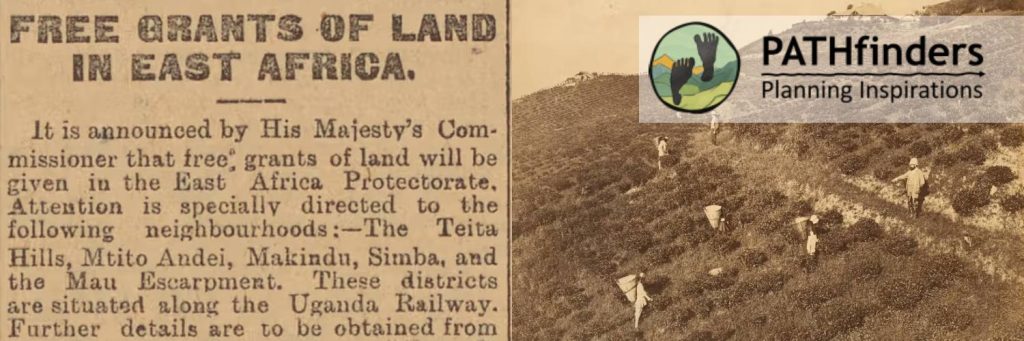
Similarly, my ‘favourite’ source from the Padlet below is an advert which appeared in the Shields Daily Gazette in 1903, offered ‘Free Grants of Land in East Africa’. Used within a lesson on the colonisation of East Africa, this source helps pupils to understand the impact of British presence and lays foundations for learning about independence in the future.
We are currently bringing our unit on the British Empire to the Curriculum PATHS Sharing Hub. You will also find Sasha Smith’s unit using the objects of empire there too.
Helpful Resources
I hope this blog helps with planning and thinking about this topic. I have included several links below to additional resources which teachers might find helpful.
History resources, textbooks, revision guides and workbooks | Hachette Learning
KS3 History Depth Study: The British Empire Student Book Second Edition: Oxford University Press
Image copyrights
‘Free Grants of Land in East Africa’, Shields Daily Gazette, 1903
Creator: Shields Daily Gazette
Copyright: Public domain
Held by British Library. Shelfmark: NEWS2643
Dooteriah Tea Estate, Darjeeling, 1870s
Creator: Robert Philips
Copyright: Public domain